

An exclusive Channel 2 Action News investigation published on April 7, 2026, found that 701 Georgians arrested for driving under the influence in 2025 had no illegal or prescription drugs in their system when their blood was tested by the Georgia Bureau of Investigation. See, Justin Gray, Blood tests show hundreds of Georgians charged with DUI were sober, WSB-TV Channel 2 Atlanta (April 7, 2026), https://www.wsbtv.com/news/local/blood-tests-show-hundreds-georgians-charged-with-dui-were-sober/6BZ7453ISNESFJ32XEL7WDBHNQ/. The number represents more than ten percent of the 6,875 blood samples the GBI processed last year, and it almost certainly understates the problem because the GBI only tests for drugs in cases where the alcohol result is under the legal limit.
The investigation, reported by Consumer Investigator Justin Gray, opens with two Georgia drivers who blew 0.000 on the breathalyzer and were arrested for DUI anyway, based on roadside field sobriety tests. One was a 65-year-old widower from Smyrna. The other was a 19-year-old college football player who had called the police himself to report a parking-lot fender bender. Both spent the night in jail. Both were ultimately cleared by laboratory blood work.
If you have been charged with operating while intoxicated in Michigan based on alleged marijuana impairment, this story is not a Georgia story. It is a Michigan story told in a Georgia accent. The same Standardized Field Sobriety Tests, the same Advanced Roadside Impaired Driving Enforcement (ARIDE) curriculum, and the same Drug Recognition Expert (DRE) protocol are deployed in Wayne County, Oakland County, Macomb County, and every other corner of this state.
What the WSB-TV Numbers Actually Show
The reporting is striking for two reasons. First, the raw count: 701 people charged in a single year in a single state with no drug or alcohol finding to support the charge. Second, the source of the recantation: Joshua Ott, a former Roswell, Georgia police officer of more than a decade who was himself an ARIDE and DRE instructor. Ott told Channel 2 Action News that he no longer believes the roadside tests he once taught are accurate for drug impairment, and he summarized the science in language no defense attorney could have improved upon: basically, the officers could have administered all these tests or flipped a quarter and they would come out with the same statistical reliability of the test.
The basis for Ott's reversal is a randomized, double-blind, placebo-controlled clinical trial conducted at the University of California, San Diego and published in JAMA Psychiatry by Dr. Thomas D. Marcotte and colleagues that I have discussed extensively over the last year. The trial reported that officers classified roughly half of placebo (sober) subjects as impaired after administering the standardized roadside tests. The WSB-TV piece cites the 49% figure.
The Michigan Court of Appeals Has Already Said So
Michigan defense attorneys have been making this argument since long before the GBI numbers came out. In 2022, the Michigan Court of Appeals held in People v Bowden that the determination under the DRE protocol that a person is ‘impaired’ and unable to safely drive a car appears to be based on the DRE officer's subjective judgment,
that the DRE protocol has not been properly tested, that it does not produce accurate and valid results, that it has no known error rate, and that DRE testimony and methodology are not reliable. The court treated the DRE conclusion as the kind of ipse dixit expert opinion that the US Supreme Court warned against in a case called Kumho Tire Co v Carmichael, 526 US 137 (1999).
Three years later, the Michigan Supreme Court reinforced the trajectory. In People v Armstrong (April 2025), the Court held that the odor of marijuana alone no longer establishes probable cause to search a vehicle. Between Bowden and Armstrong, the Michigan's higher courts have systematically reduced the evidentiary weight of the most common police observations in a marijuana-related stop, but ARIDE and DRE tests are still being used on a daily basis throughout Michigan.
The Science the Prosecution Does Not Want to Discuss
The Marcotte JAMA paper is not the only study undermining roadside drug-impairment testing. In April 2021, researchers supported by the National Institute of Justice reported that field sobriety tests and THC blood levels are both unreliable indicators of cannabis intoxication. National Institute of Justice, Field Sobriety Tests and THC Levels Unreliable Indicators of Marijuana Intoxication (April 2021), https://nij.ojp.gov/. Independent methodological review of the three foundational DRE validation studies — Bigelow, Compton, and Adler — concluded that none of them validates the protocol as it is administered today. See, Greg Kane, The methodological quality of three foundational law enforcement drug influence evaluation validation studies, 12:16 Journal of Negative Results in BioMedicine (2013). The Arizona DRE study, for example, claimed 83.5% accuracy. Properly analyzed, the figure is closer to 43%.
None of the individual roadside tests fares better when examined honestly. Horizontal Gaze Nystagmus and Vertical Gaze Nystagmus are not marijuana tests; marijuana does not induce nystagmus, and HGN evidence in Michigan is admissible only to establish the presence of alcohol. The Lack of Convergence test, invented in the Adler study, produced positive readings in more than half of suspects regardless of the drug at issue, which means it cannot meaningfully discriminate between drug categories. The Modified Romberg balance test has never been admitted in a Michigan court under Daubert or Frye, and the Finger-to-Nose test was rejected by the Southern California Research Institute in 1977 as unreliable.
The pattern is the one Officer Ott described to WSB-TV: a coin flip, dressed up in a clipboard.
What This Means If You Are Charged in Michigan
Michigan charges marijuana-related impaired driving under several theories: operating while visibly impaired, operating while intoxicated, and operating with the presence of a Schedule 1 controlled substance under MCL 257.625(8). The Michigan Medical Marihuana Act and the Michigan Regulation and Taxation of Marihuana Act both interact with the statute in ways the prosecution often ignores. In practice, the police case against a Michigan driver suspected of marijuana use frequently rests on (1) field sobriety tests, (2) the officer's subjective judgment, and (3) a DRE evaluation conducted at the station.
Under MRE 702 and MRE 703, expert testimony must rest on sufficient facts and reliable principles applied reliably to the facts of the case. The WSB-TV investigation, the JAMA trial, the NIJ research, the methodological critiques of the validation studies, and the Court of Appeals' own analysis in Bowden all point in the same direction: the methodology does not meet that standard for marijuana cases.
Watch the Full 50-Minute Presentation
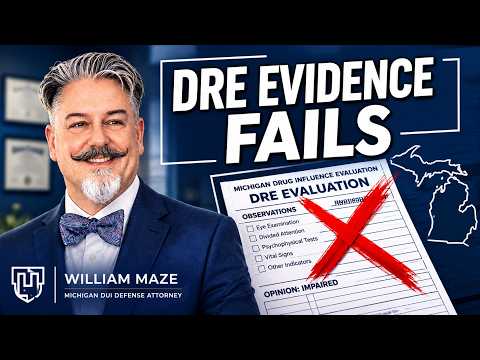
Michigan Marijuana DUI: Why DRE Officers Get It Wrong
William J. Maze of Maze Legal PLC presents a defense-perspective analysis of marijuana, traffic cases, and the post-Bowden Michigan landscape, with extensive discussion of the JAMA Psychiatry Marcotte trial, the National Institute of Justice 2021 study, and the methodological failures of the Bigelow, Compton, and Adler validation studies.
- People v Bowden & the DRE protocol
- MRE 702 and MRE 703 challenges
- HGN, VGN, lack of convergence, modified Romberg
- JAMA Psychiatry Marcotte clinical trial
- National Institute of Justice cannabis research
